
DSCR Loans Program
Commercial Real Estate Financing Based on Property Cash Flow
Real estate investors don’t always fit traditional lending guidelines. Self-employed borrowers, experienced investors, and property owners may have substantial assets and successful portfolios while their personal tax returns don’t fully reflect their financial strength.
A DSCR Loan (Debt Service Coverage Ratio Loan) provides an alternative financing solution that focuses primarily on the income and cash flow generated by the property.
At SBAcommercialloans.com, we provide access to DSCR financing for qualified real estate investors purchasing or refinancing income-producing properties.


Program Overview
What Is a DSCR Loan?
DSCR stands for Debt Service Coverage Ratio, financial measurement lenders use to determine whether a property’s income is sufficient to cover its debt obligations.
The basic calculation is:
DSCR = Net Operating Income (NOI) ÷ Annual Debt Service
For example, if a property generates $125,000 in annual net operating income and has $100,000 in annual debt payments, the property’s DSCR would be 1.25x.
A DSCR above 1.00 indicates that property income exceeds its debt service. Actual minimum DSCR requirements vary by lender, property type, leverage, and loan program.
Uses
Purchase & Refinance Options
DSCR financing may be used for both commercial real estate acquisitions and refinances.
Investors purchasing income-producing properties may qualify primarily based on property cash flow and other transaction characteristics.
Existing owners may consider DSCR refinancing to replace maturing debt, restructure financing, potentially access property equity where permitted, or transition from short-term financing into a longer-term loan.

Underwriting
How Are DSCR Loans Underwritten?
Although property cash flow is a major consideration, lenders typically evaluate the complete transaction. Factors may include:
Property Net Operating Income (NOI)
Debt Service Coverage Ratio (DSCR)
Property value
Loan-to-value ratio (LTV)
Occupancy
Property condition and location
Borrower credit profile
Liquidity and reserves
Real estate experience
Higher property cash flow relative to debt generally provides a greater financial cushion for the lender.
Comparison

DSCR vs. No Doc & Lite Doc Loans
A DSCR loan focuses primarily on whether property income can support the proposed debt.
A Lite Doc loan requires less financial documentation than conventional financing, while a No Doc loan places less emphasis on traditional personal or business income documentation.
The best program depends on the property’s cash flow, borrower profile, available equity, and financing objectives.
Comparison
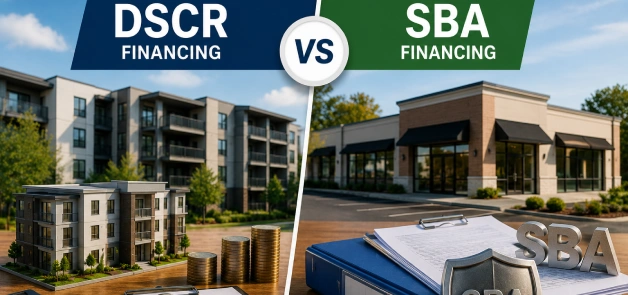
DSCR vs. SBA Financing
DSCR and SBA loans generally serve different purposes. DSCR financing is primarily designed for income-producing investment properties.
SBA financing is generally intended for eligible operating businesses, including businesses purchasing owner-occupied commercial real estate.
If you’re purchasing a property primarily for investment and rental income, a DSCR loan may be more appropriate than an SBA loan.
Next Step
Find the Right DSCR Loan
Tell us about your property, rental income, purchase price or value, requested loan amount, occupancy, and financing objectives.
Our commercial lending team can evaluate DSCR, No Doc, Lite Doc, Bridge, Conventional, Fannie Mae, Freddie Mac, FHA/HUD, and other commercial financing options for your transaction.
Finance Your Investment Property
REQUEST A DSCR LOAN QUOTE
DSCR financing is subject to lender underwriting, property eligibility, valuation, credit requirements, DSCR and LTV requirements, and program availability.
Ready to Explore Your Financing Options?
Whether you're purchasing a business, buying commercial real estate, refinancing existing debt, or expanding your operations, our team is here to help you understand your financing options.

Loan Programs
Company
Contact Us
- 855-90-MYSBA
- sales@sbacommercialloans.com
- 13000 Harbor Dr Suite 228D,
Woodbridge, VA 22192 - Mon - Fri: 10:00 AM - 7:00 PM
SBAcommercialloans.com is operated by Commercial Lending USA. Financing is subject to lender approval, SBA eligibility requirements, underwriting, credit review, and applicable program guidelines. Not all applicants or transactions will qualify. Loan terms, rates, and program availability may vary based on borrower qualifications and lender requirements.
BBB Member

We're A Member Of

© 2026 SBACommercialLoans.com. All rights reserved.