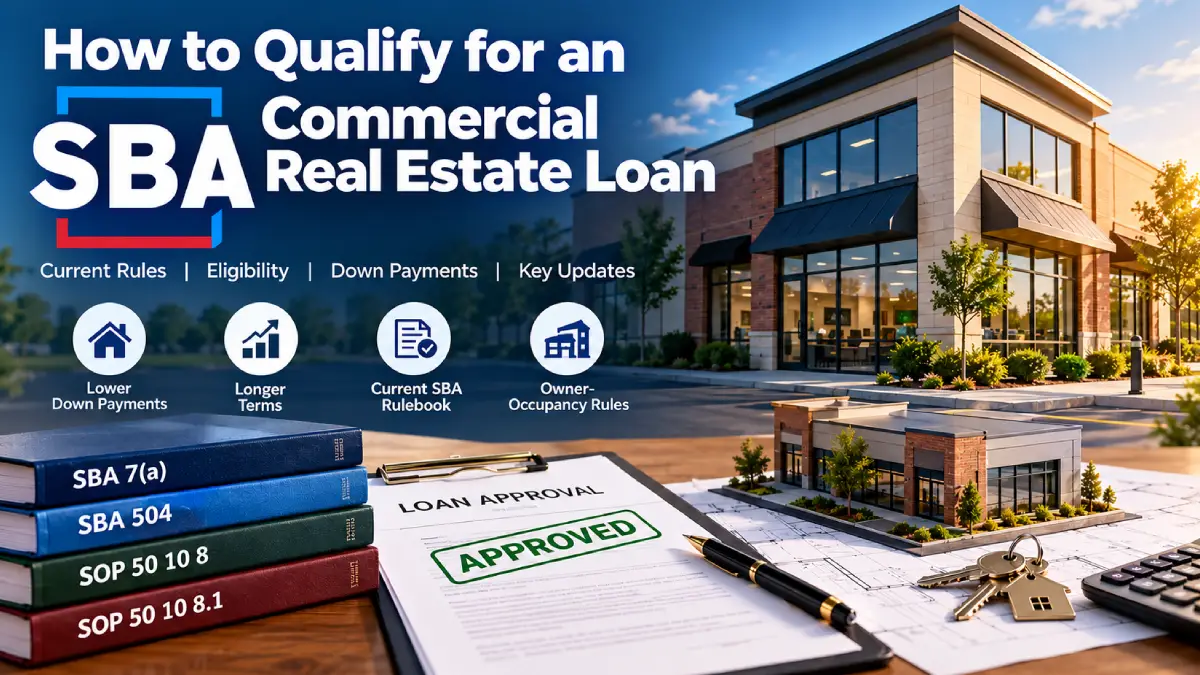
Big national banks turn down most small business loan applications. Meanwhile, commercial real estate remains one of the largest assets a small business can hold. Every deal you delay is a property another buyer can close on. This guide walks through exactly what it takes to qualify for an SBA commercial real estate loan in 2026, using the current SBA rulebook, not outdated figures.
What an SBA Commercial Real Estate Loan Actually Is
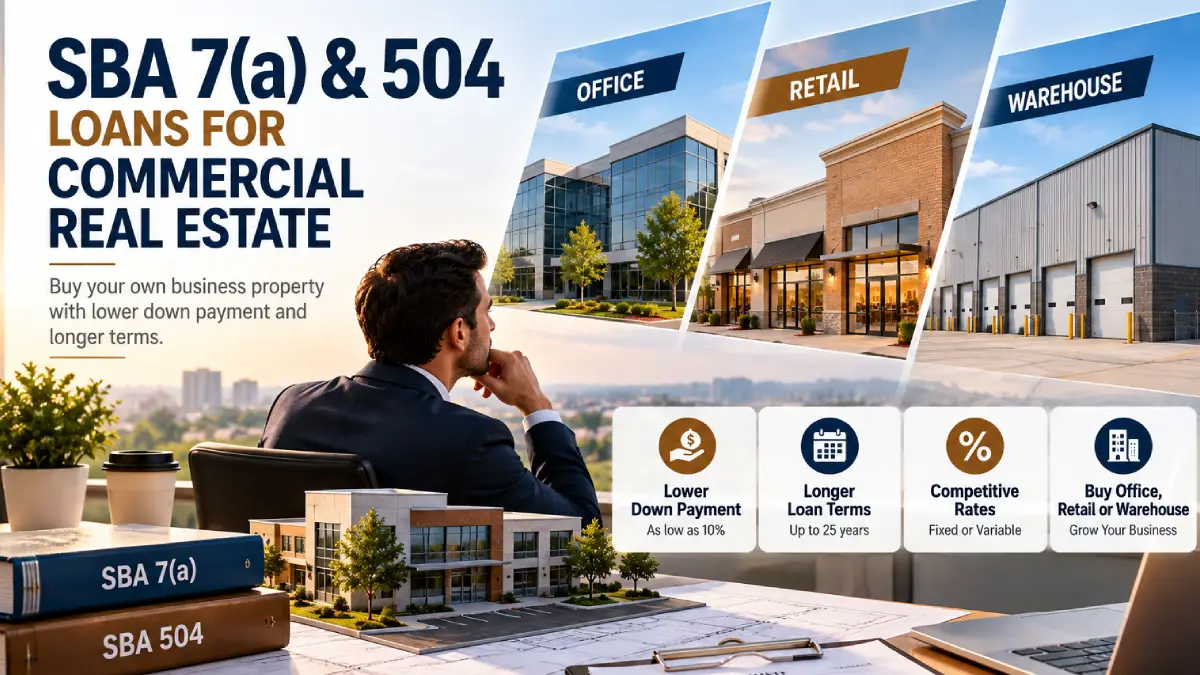
The SBA does not lend you money directly. It guarantees a portion of the loan that a private lender issues, which lowers the lender’s risk and opens the door to lower down payments and longer terms than a conventional mortgage.
The guarantee amount depends on the program and loan size. On a standard SBA 7(a) loan, the guarantee is 85% for loans of $150,000 or less and 75% for loans above that, which covers most real estate purchases. On an SBA 504 loan, the structure works differently: a bank funds 50% of the project, a nonprofit Certified Development Company funds 40% through an SBA-backed debenture, and you put down 10%.
Core Eligibility Requirements for How to Qualify for an SBA Commercial Real Estate Loan
Your business must clear several baseline standards before a lender will even look at your file:
- You operate as a for-profit entity. Nonprofits do not qualify.
- Your business operates physically in the United States or its territories.
- You cannot get comparable credit terms without the federal guarantee.
- Your business fits SBA’s size limits.
Under the current alternative size standard, your business must have a tangible net worth of $20 million or less and average net income after federal taxes of $6.5 million or less over the past two fiscal years. That threshold was set in March 2024 and has not changed since.
What’s Actually New in the SBA Rulebook
SBA policy has shifted twice recently, and the two changes get confused often.
SOP 50 10 8, effective June 1, 2025, tightened equity injection rules on business acquisitions. A seller note can now cover no more than half of a required down payment, and it must sit on full standby with no payments until the SBA loan is repaid.
SOP 50 10 8.1, published in August 2026, takes effect October 1, 2026. It raises the debt service coverage floor to 1.25x for first-time acquisitions and owner buyouts, while expansions stay at 1.15x. It also adds a lender-ordered Quality of Earnings report on deals of $3 million or more. If your loan number gets issued before October 1, 2026, the older standard still applies.
Separately, since March 1, 2026, SBA has required 100% U.S. citizenship or national status for owners, a stricter standard than the prior rule that also allowed permanent residents.
If you’re mid-deal, ask your lender in writing which rulebook governs your specific application.
Property Occupancy Rules
The strictest rule in SBA real estate lending is owner occupancy. These loans exist to support businesses that operate out of the property, not passive landlords.
- Existing buildings: your business must occupy at least 51% of the rentable space at closing.
- New construction: your business must occupy at least 60% at completion, with a plan to reach 80% over time.
You can lease out the remaining space to third-party tenants and use that rental income to help cover your mortgage. What you cannot do is buy a property purely to collect rent. Apartment buildings and shopping centers bought as pure investments are ineligible.
Assisted living facilities, memory care centers, and nursing homes are treated differently from age-restricted apartments. Because they provide active daily care rather than passive housing, they qualify as operating businesses under both the SBA 7(a) and SBA 504 programs.
Debt Service Coverage and Credit
Lenders care more about your cash flow than your property’s value because they want assurance you can make every payment. This is measured with the debt service coverage ratio:
DSCR = Net Operating Income ÷ Annual Principal and Interest Payments
Most lenders currently require a historical DSCR between 1.15x and 1.25x, verified against your trailing 12 months of financials or tax returns. Under SOP 50 10 8.1, that floor rises to 1.25x for acquisition-type deals starting in October 2026.
On credit, the SBA sets no absolute minimum score. Individual lenders do. Most look for a personal FICO score of 680 or higher from every owner with significant equity. A score between 650 and 679 can still work if your cash flow, industry experience, or liquid reserves are strong.
Down Payment Requirements
- Existing multi-use building, established business: 10% down
- Special-purpose property (hotels, car washes, gas stations): 15% down
- Startup business under two years old: 15% down
- Startup purchasing a special-purpose property: 20% down
On a 504 loan, this 10% figure is structural. The 50/40/10 split between bank, CDC, and borrower isn’t negotiable, and the deal can’t close without your full contribution.
Collateral and Personal Guarantees
Beyond the property itself, current SBA rules require liens on personal real estate for owners with 25% or more equity when their personal collateral is available. Every owner with 20% or more equity must sign a personal guarantee, and in many states, spouses may need to sign as well.
Documentation Checklist For How To Qualify for an SBA Commercial Real Estate Loan
Gather these before you apply to avoid delays:
- Three years of signed federal business tax returns
- Three years of signed personal federal tax returns for owners with 20% or more equity
- Year-to-date profit and loss statement and balance sheet dated within 60 to 120 days
- A detailed business debt schedule
- Completed SBA Form 1919 and Personal Financial Statement (SBA Form 413)
- Purchase agreement or construction cost estimates
- A USPAP-compliant appraisal less than 12 months old, ordered by the lender
Why Lenders Reject Applications
The most common reasons deals fall apart:
- DSCR falling below the required historical floor
- Trying to finance purely passive rental property
- An owner appearing on the federal CAIVRS default database
- Mismatches between internal financials and tax filings
- Using borrowed or undocumented funds to cover the down payment
Fixing these before you submit an application meaningfully improves your odds.
SBA Loans vs. Other Commercial Financing
SBA loans offer the lowest down payments and the longest fully amortizing terms in the market, but they move slower than conventional financing and come with occupancy restrictions. Conventional commercial mortgages close faster and allow 100% leased investment property, but typically require 20% to 35% down and shorter balloon terms. If your deal doesn’t fit SBA’s owner-occupancy rule, bridge loans, DSCR investment loans, or conventional commercial mortgages may be a better structural fit.
The 2026 Refinancing Window
A large share of commercial real estate debt originated a decade ago is coming due in 2026, and much of it was priced well below today’s rates. Business owners with loans maturing this year should start the refinancing conversation early, since SBA underwriting on a refinance follows the same DSCR and documentation standards as a purchase.
Action Plan
- Confirm your business will occupy at least 51% of the space and that owner credit scores clear 680.
- Calculate your historical DSCR and set aside 10% to 20% in verified cash for your down payment.
- Assemble your tax returns, financial statements, and SBA forms.
- Work with a lender or broker who underwrites SBA commercial real estate deals regularly.
Get pre-qualified or explore our full range of loan programs to see which structure fits your property.
FAQs
Can a lender put a lien on your home for an SBA loan?
Yes, if your business collateral doesn’t fully cover the loan, lenders may place a lien on personal real estate for owners with significant equity.
Can you use an SBA loan for a partner buyout?
Yes, subject to the current equity injection and seller-note rules under SOP 50 10 8.
Is life insurance required for SBA loan approval?
Many lenders require a collateral-assignment life insurance policy on key owners, though this is a lender requirement rather than a blanket SBA rule.
Are franchise properties eligible?
Yes, provided the franchise brand appears on SBA’s franchise directory.
Can two SBA loans be combined for one property?
Yes, SBA programs can be layered on larger development projects, structured correctly by an experienced lender.
Visit our resource center for more on SBA loan structuring and current qualification standards.