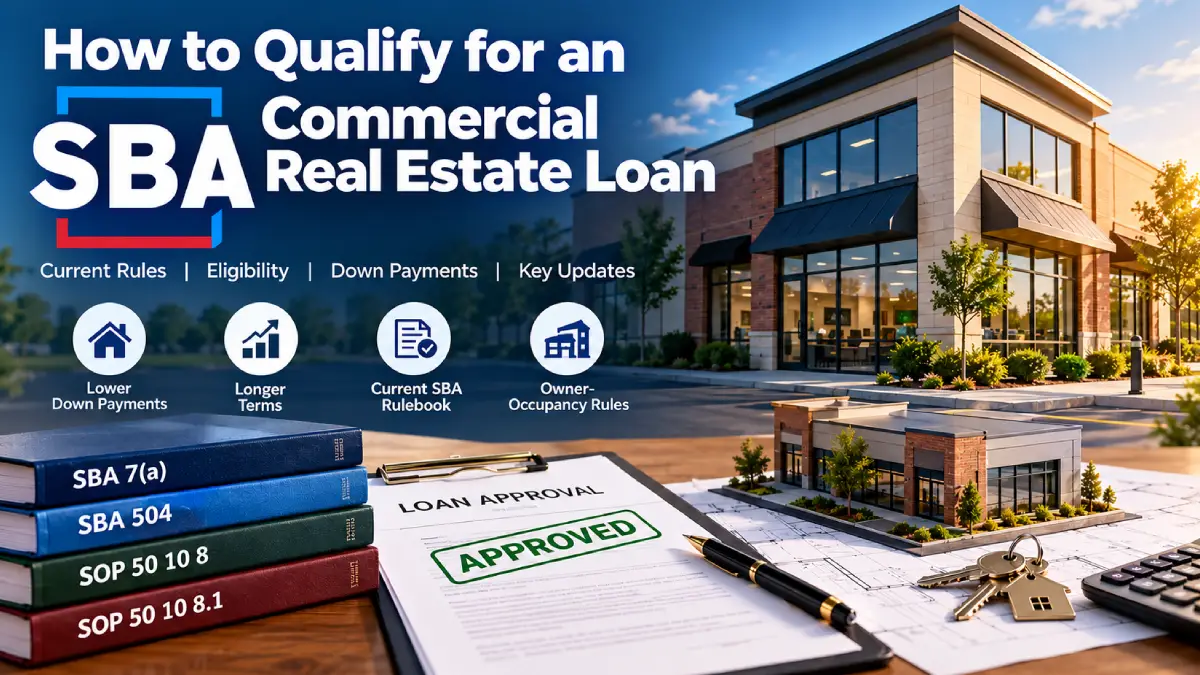
The Small Business Administration guaranteed a record $44.8 billion in 7(a) and sba 504 loans in fiscal year 2025, spread across $84,400 loans. That is real money moving into real buildings, and much of it went to small business owners buying their own offices, warehouses, and storefronts instead of renting them.
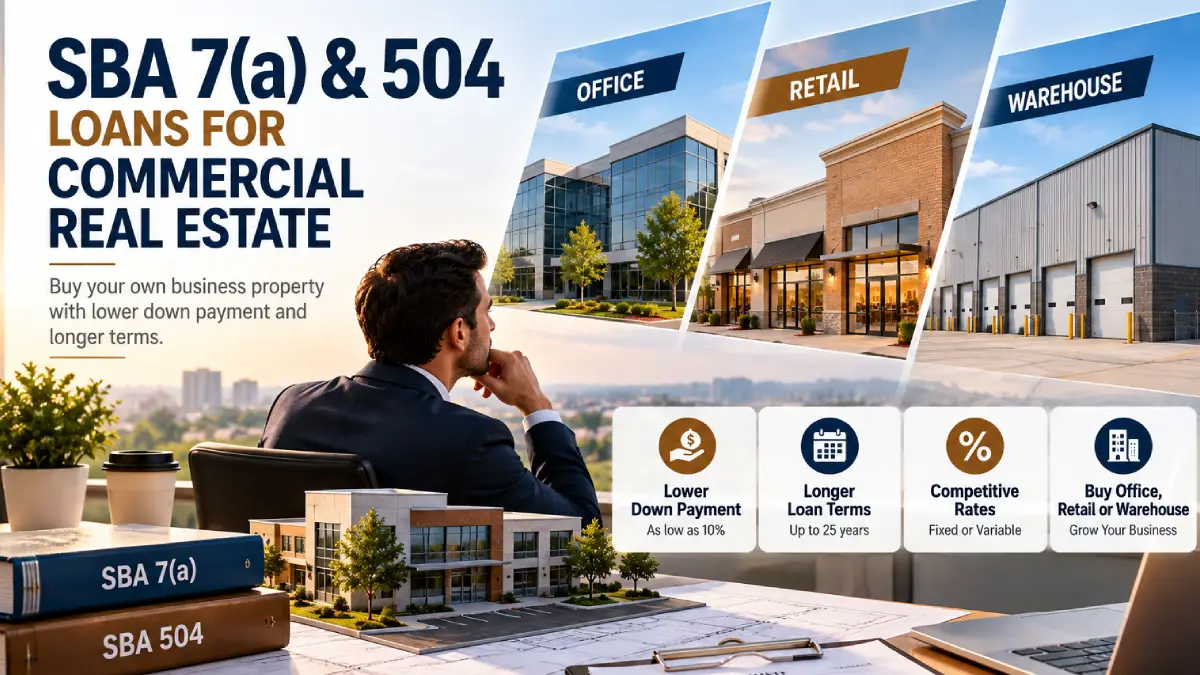
Banks are not making this easy on their own. A standard bank loan often asks for 25% to 35% down, plus a balloon payment in five to ten years. That balloon can force a full refinance right when you can least afford one. Government-backed loans fix both problems. You can put down as little as 10%, and you get up to 25 years to pay the loan off in full.
This guide walks through how these loans work, who qualifies, and what changed in the rules for 2026.
SBA 7(a) or SBA 504: Which One Fits?
You have two main paths for commercial real estate loans, and they work differently.
The SBA 7(a) loan goes up to $5 million. It is the flexible option. You can use it to buy a building, buy out a partner, purchase inventory, and cover working capital, all in one loan. Rates are usually variable, tied to the prime rate.
The SBA 504 loan is built for large real estate and equipment purchases. It splits the deal into three pieces. A bank funds 50% of the cost. A Certified Development Company, or CDC, funds another 40% at a fixed rate. You put down the remaining 10% in cash.
| Loan Feature | SBA 7(a) | SBA 504 | Standard Bank Loan |
| Max Loan Size | $5 million | $5 million ($5.5 million for manufacturers and qualifying energy projects) | Varies by lender |
| Down Payment | 10% to 15% | 10% to 20% | 25% to 35% |
| Loan Term | Up to 25 years | 10, 20, or 25 years | 5 to 10 years, often with a balloon |
| Rate Type | Usually variable | Fixed for the life of the loan | Market rate, varies |
| Prepayment Penalty | None under 15-year terms | Yes, for the first 10 years, declining each year | Varies by lender |
One 2026 update worth knowing: as of July 4, 2026, the SBA raised the combined outstanding balance a single borrower can carry across both programs together to $10 million. The cap on any one loan has not changed. A business could now hold a $5 million 7(a) loan and a separate $5 million sba 504 loan at the same time, something the old rules did not allow.
Do You Meet the Basic SBA commercial real estate loan requirements?
The rules are simpler than most owners expect.
Your business must be a for-profit company operating in the United States. Your tangible net worth must stay under $20 million. Your average net income after federal taxes, for the two years before you apply, must stay under $6.5 million. Most independent owners fit inside these limits without trouble.
Lenders also want to see a track record. Two full years in business is the standard benchmark, and it gets you the smoothest path to a 10% down payment. A newer business can still qualify, but expect a 15% down payment request and a lender who wants to see a solid business plan.
Credit matters too. The SBA itself sets no hard credit floor, but the lenders who fund these loans do. Most want a personal FICO score of 660 to 680 or higher from anyone who owns 20% or more of the business. Lenders also run an automated FICO Small Business Scoring System, or SBSS, check, and a score of 155 or higher generally clears pre-screening without extra delay.
As of March 1, 2026, there is a new rule to know: every direct and indirect owner of 20% or more must be a U.S. citizen or U.S. national. This is a change from prior years, so confirm current status with your lender before you assume you qualify.
The Owner-Occupancy Rules, Explained Simply
This trips up a lot of real estate investors, so it is worth spelling out clearly. These loans exist to house active operating businesses. They are not built for passive landlords.
If you are buying an existing building, your business must occupy at least 51% of the total rentable space right away. You can lease out the other 49% to outside tenants, and that rental income can help cover your mortgage.
If you are building new construction, the bar is higher. You must occupy at least 60% of the space on day one, with a plan to grow into 80% within 10 years.
Can you use one of these loans for a purely income-generating property, like an apartment building or a single-family rental? No. The SBA turns down passive real estate investments outright. But if your active business meets the occupancy rule, renting out the leftover space is completely fine.
For multi-tenant buildings sitting on a single land parcel, your business needs to occupy 51% of the total space within 12 months. If the property spans several separate parcels, your business must occupy 51% of each parcel individually, unless you combine them under one legal title before applying.
A common workaround here is setting up an Eligible Passive Company, or EPC, that holds the property title and leases the whole building to your Operating Company. Your Operating Company can then sublease up to 49% of the space to outside tenants. Talk to your lender before setting this up, since the paperwork has to match SBA rules exactly.
What About Hotels and Senior Housing?
Senior care facilities can qualify, but the deciding factor is the level of service on-site. An assisted living facility, memory care unit, or nursing home qualifies because it delivers active daily care such as medical oversight, meals, and staff monitoring. Independent senior living apartments that just collect monthly rent do not qualify, since the SBA treats that as passive residential real estate.
Hotels and other short-term lodging properties are a different story. Because guests stay under short-term room agreements rather than leases, the entire property counts as owner-occupied business real estate. Hospitality has become one of the largest users of 504 financing in recent years.
How Lenders Judge Your Cash Flow
Lenders check one number above almost everything else: the debt service coverage ratio, or DSCR. It compares your net operating income to your annual loan payments.
DSCR = (Net Operating Income + Depreciation + Amortization) ÷ (Annual Loan Principal + Annual Loan Interest)
Most lenders want a DSCR of at least 1.15 to 1.25 based on your past tax returns. In plain terms, for every $1.00 of loan payment, your business should be generating $1.15 to $1.25 in net operating income. New construction projects need to show a projected DSCR of at least 1.25 within 12 to 24 months of opening.
Down payment requirements scale with risk, in three tiers:
Tier 1, 10% down: standard commercial property (office, retail, industrial, warehouse) for a business open two years or more.
Tier 2, 15% down: a special-use property such as a hotel, assisted living facility, car wash, or gas station, or a business open less than two years.
Tier 3, 20% down: a startup under two years old buying or building a special-use property, combining both risk factors at once.
Compare that to a conventional commercial loan, which typically wants 25% to 35% down at closing. Keeping 15 to 25 percentage points of cash in your business instead of tying it up in a down payment is often the single biggest advantage of going the government-backed route.
What Else Factors Into the Total Cost
Two things competitors rarely spell out clearly: prepayment penalties and closing costs.
On a sba 504 loan, a prepayment penalty applies only during the first 10 years and shrinks a little each year, with nothing owed after that. A 7(a) loan with a term under 15 years carries no prepayment penalty at all; longer terms carry a declining penalty only if you pay off more than 25% of the balance in the first three years.
Closing costs on a sba 504 loan typically run 2% to 3% of the loan amount, covering items like the CDC processing fee, guarantee fee, title work, and appraisal. Most of these fees get rolled into the loan itself, which keeps your upfront cash need low.
Plan for a real timeline too. Between the appraisal, environmental review, and SBA processing, a commercial real estate closing typically takes 75 to 90 days from application to funding. Deals that need new construction or an environmental cleanup can run longer.
Documents to Have Ready
Getting your paperwork organized before you make an offer speeds up everything that follows. A typical lender will ask for:
Three years of signed federal business tax returns (Form 1120, 1120-S, or 1065).
A year-to-date profit and loss statement and balance sheet, dated within 90 days.
A completed debt schedule (SBA Form 2202) listing every existing business debt.
Three years of personal tax returns for every owner holding 20% or more equity.
A personal financial statement (SBA Form 413) for those same owners.
A signed borrower information form (SBA Form 1919).
Property documents: purchase agreement, current leases, a Phase I environmental site assessment, and an independent appraisal.
Why Applications Get Denied
Knowing the common dealbreakers ahead of time lets you fix them before they cost you a deal.
Weak cash flow that falls short of the 1.15x DSCR floor is the most common reason. Occupancy failures come next, where the business will not actually use 51% of an existing building or 60% of new construction. Unresolved federal debt, such as a defaulted prior government loan or unpaid back taxes without an approved IRS payment plan, is an automatic red flag. So is personal credit below roughly 660, or down payment funds a borrower cannot document as their own for at least 90 days.
If a lender turns you down, that is not necessarily the end of the road. Alternative structures, from bridge loans to DSCR-based investor loans, exist specifically for deals that do not fit the standard box.
Getting Started
Meeting these requirements gets you access to fixed rates well below conventional bank pricing, repayment terms up to 25 years, and a down payment as low as 10%. The rules changed meaningfully for 2026, from the new combined loan cap to the updated ownership eligibility standard, so it is worth confirming your specific numbers before you go under contract on a property.
Reach out to our team to walk through your deal, or start with our overview of SBA loan programs and our lending resource library to see which structure fits your situation. You can also find free, independent guidance through your local SCORE mentor, a nonprofit partner of the SBA.
Frequently Asked Questions
Can foreign nationals qualify for an SBA commercial real estate loan?
As of March 1, 2026, every owner holding 20% or more of the business must be a U.S. citizen or U.S. national. This is a stricter standard than in past years, so confirm your ownership structure with a lender early.
Can you refinance existing bank debt with an SBA loan?
Yes. Business owners refinance conventional commercial mortgages into SBA financing when the current payment is straining cash flow, often to escape an approaching balloon payment.
Does a spouse have to sign a personal guarantee?
Generally yes, if the spouse owns 20% or more of the company or is pledging personal property, such as a home, as collateral.
Does seller financing count toward the down payment?
It can, as long as the seller note stays on full standby for the life of the SBA loan, meaning no payments to the seller until the SBA debt is satisfied.
Will a past tax lien block approval?
An open, unresolved tax lien will block funding. An active, current IRS payment plan with a documented payment history is usually enough to move forward.